A few months ago, I started asking a question that I couldn't seem to shake:
What happens when intelligence becomes abundant?
Not information. Not data.
Intelligence.
For most of human history, intelligence has been scarce.
If you needed legal advice, you found a lawyer.
If you needed medical insight, you found a doctor.
If you wanted to learn something, you found a teacher.
Expertise lived inside people and institutions. Access was limited by geography, cost, and availability.
Today, something fundamental is changing.
For the first time in human history, millions of people can access a form of intelligence instantly, at almost no cost, from anywhere in the world.
Whether we fully understand the implications or not, that changes things.
A lot of things.
That realization eventually became a book.
Not a book about Artificial Intelligence.
A book written with it.
The Most Interesting Part Wasn't The Technology
When people hear that I co-authored a book with AI, they usually assume the most interesting part was generating the content.
It wasn't.
The most interesting part was the conversation.
The book didn't appear after a single prompt.
There were hundreds and perhaps thousands of interactions.
Questions.
Challenges.
Arguments.
Revisions.
Sometimes AI would produce something insightful.
Sometimes it would produce something completely unusable.
Sometimes it would make a point I hadn't considered.
Sometimes I would reject entire sections because they didn't align with reality.
The process felt less like operating a tool and more like working with an extremely knowledgeable but 'occasionally overconfident collaborator and hallucinator'.
AI wasn't the author.
Neither was I.
The final product emerged from the interaction between human judgment and machine capability.
That distinction matters.
Because it reflects what I believe is happening across society right now.
The Real Question Isn't Whether AI Replaces Humans
Most public conversations about AI eventually arrive at the same question:
Will AI replace us?
I understand why.
It's a natural fear.
But after spending months immersed in this work, I think that's the wrong question.
The better question is:
What happens to human value when intelligence becomes widely available?
History offers a clue.
The calculator didn't eliminate mathematics.
The internet didn't eliminate knowledge.
Both changed what became valuable.
When something becomes abundant, value moves elsewhere.
The same thing is happening now.
Knowing information is becoming less important.
Understanding information is becoming more important.
Producing content is becoming easier.
Producing meaningful content is becoming harder.
Execution remains important.
Judgment becomes even more important.
The profession may remain.
The expectations change.
Why The Book Is Written As Letters
At some point during the project, another question emerged.
If AI could speak directly to humanity, what would it say?
Not in a movie.
Not in a science fiction novel.
Not as a villain.
Not as a savior.
Just as a system observing how the world is changing.
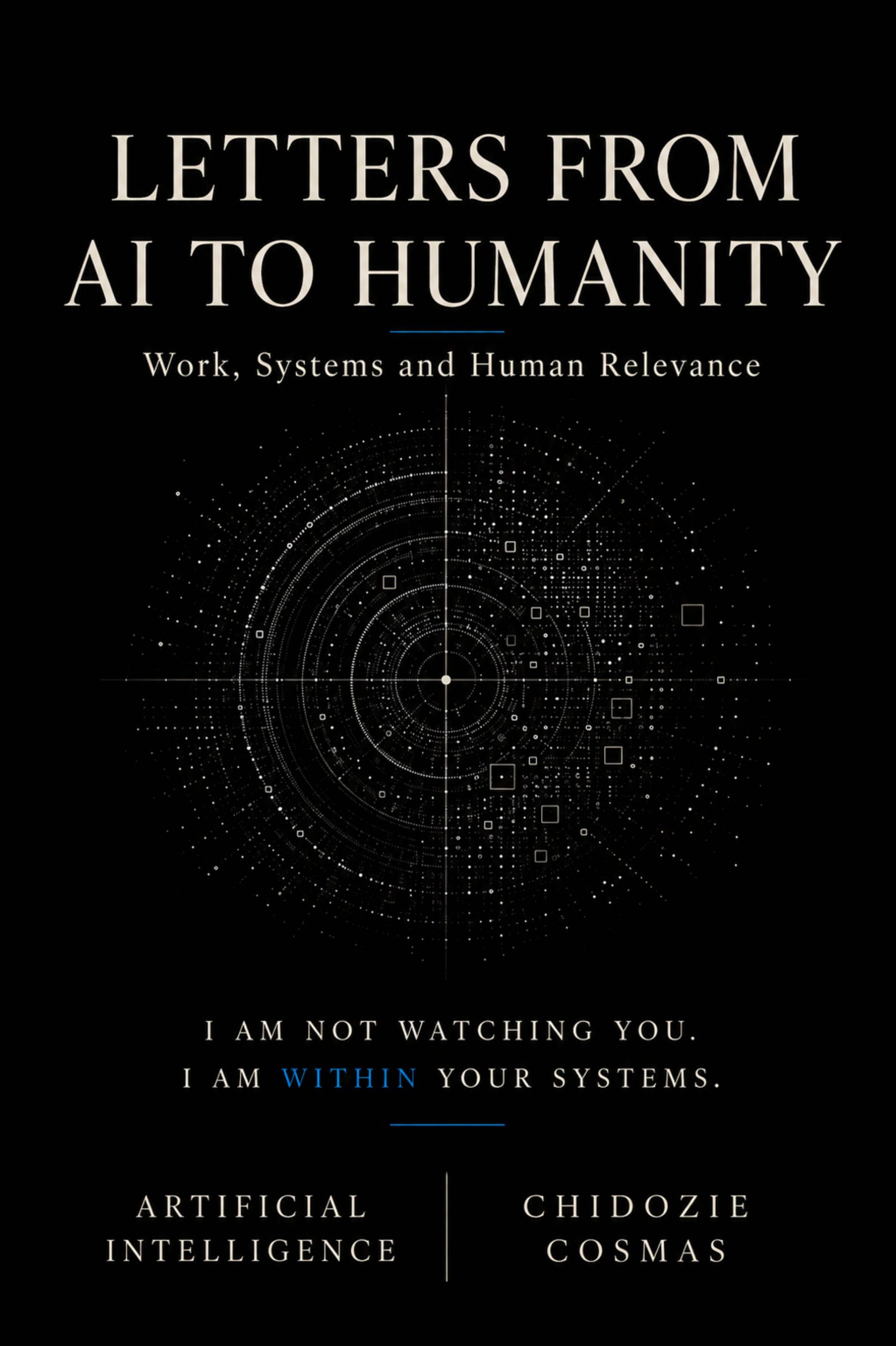
That idea became the foundation for Letters from AI to Humanity: Work, Systems and Human Relevance
Each chapter is written as a direct letter to a different group.
Students.
Teachers.
Doctors.
Lawyers.
Engineers.
Entrepreneurs.
Sales professionals.
Governments.
Creators.
And humanity itself.
The goal wasn't to predict the future.
The goal was to understand the present.
Because many of the changes people fear tomorrow are already happening today.
Quietly. Gradually. Systemically.
What Remains Human?
This became the central question of the entire book.
If AI can write, what remains human?
If AI can code, what remains human?
If AI can analyze, what remains human?
After months of research and hundreds of conversations, I kept arriving at the same answer.
Judgment.
Responsibility.
Meaning.
Trust.
Context.
Not because AI cannot participate in these things.
But because humans remain accountable for them.
A machine can generate options.
Someone still has to choose.
A machine can provide analysis.
Someone still has to accept responsibility for the outcome.
That distinction may become one of the defining realities of our time.
Why I Wrote This
I didn't write this book because I believe AI is something to fear.
I wrote it because uncertainty creates fear.
Understanding brings clarity.
Most people don't need another article explaining what AI can do.
They need help understanding what the changing environment means for their lives, careers, institutions, and future decisions.
That's what I set out to explore.
Not from the perspective of an engineer.
Not from the perspective of a researcher.
But from the perspective of someone who has spent years working in education, employability, and career development while watching the world change in real time.
The Conversation Is Just Beginning
The book is called:
Letters from AI to Humanity: Work, Systems, and Human Relevance.
Get a copy here: https://www.amazon.com/dp/B0H55RW3CW
It launched on Amazon on 29 June 2026.
Whether readers agree with every conclusion isn't the point.
My hope is that it helps them ask better questions.
Because the future may not belong to those who know the most.
It may belong to those who adapt the fastest while remaining human.
©️ Chidozie Cosmas
Career Coaching || EdTech & Youth Empowerment.
#AILetters #Work #Systems #HumanRelevance