This is not what I'd normally talk about but here I am.
I have watched ordinary people, capable businesses, countries and entire industries slowly strangled under rules they never voted for and can barely understand. What began as common-sense protections has quietly evolved into something else entirely.
There was a time when regulation claimed a clear, protective purpose: safeguard consumers, protect the environment, prevent fraud, and keep markets fair. Society requires basic ground rules to function. However, a cold analysis of policy shifts and market dynamics over recent decades reveals a much darker reality. Regulation has ceased to be a protective guardrail. It has been deliberately transformed into a discretionary gatekeeper, a financial barrier, and ultimately, an offensive weapon.
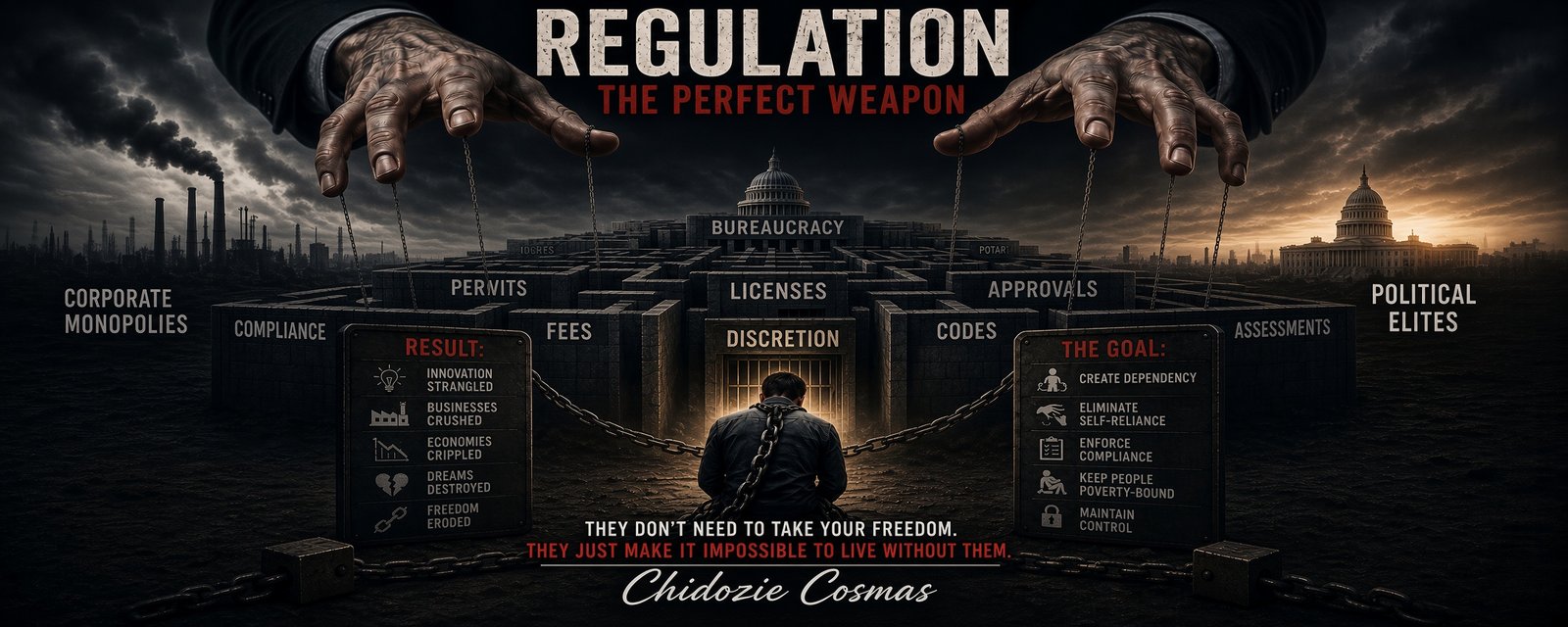
Once an administrative body or an entrenched cartel controls the gate to decide who operates, who waits, who pays, who gets inspected, and who is denied permission, regulation stops being about safety. It becomes a mechanism of deliberate economic warfare. This weaponisation is not an accidental byproduct of well-meaning governance; it is an intentional strategy deployed to strangle innovation, impoverish populations, destroy self-reliance, and force non-compliant actors to bend the knee.
The Mechanism of Modern Gatekeeping
Regulatory weaponisation rarely announces itself with an explicit prohibition. Its most effective form is administrative attrition: a relentless accumulation of permits, environmental impact assessments, mandatory reporting obligations, licensing fees, and compliance certificates.
This accumulation is engineered with purpose. Entrenched corporate monopolies and political elites actively shape these frameworks to create artificial barriers to entry. Large incumbents easily absorb these fixed administrative costs by expanding their legal departments, effectively converting regulatory complexity into an impassable moat.
For the startup, the independent entrepreneur, or the disruptive innovator, this same complexity is lethal. It is designed to drain capital, delay deployment, and force small players out of the market before they can ever compete.
The result is a calculated shift in economic incentives. Capital that should fund research, development, and value creation is forcibly diverted into navigating administrative machinery. Innovation becomes entirely defensive: engineers are forced to design for the approval of bureaucrats rather than the needs of users, and businesses are compelled to optimize for political alignment rather than market excellence.
Industrial Stagnation and the Stratego of Technical Drag
The industrial consequences of this strategy are most visible in high-stakes technology sectors, particularly aerospace and advanced engineering.
SpaceX stands as a prime case study of an innovator fighting a system designed to slow it down. The company’s core advantage relies on rapid, iterative development: build, test, learn, modify, and test again. Yet, administrative bodies have repeatedly used environmental reviews, launch licensing delays, and endless procedural inquiries to throttle this rapid progress. When approval timelines are intentionally stretched to move slower than the underlying engineering, the regulator ceases to monitor safety; it acts as an institutional brake specifically designed to control the pace of private disruption.
This structural drag creates devastating geopolitical and economic asymmetries. Consider the stark contrast between commercial space development in the United States, China, and Europe.
While private entities in the United States struggle against regulatory friction and China aggressively funds and accelerates its state-backed aerospace systems, Europe has effectively been sidelined. Europe does not lack brilliant scientists, world-class engineers, or financial resources. What it lacks is an environment free from regulatory strangleholds. Bound by fragmented national jurisdictions, rigid procurement mandates, risk-averse bureaucratic structures, and stifling compliance burdens, Europe has engineered its own launch deficit. By prioritizing administrative process over technological execution, European institutions have crippled their own aerospace sovereignty, leaving an entire continent dependent on foreign platforms.
Nuclear energy demonstrates the same deliberate paralysis. Decades of escalating regulatory requirements, arbitrary redesign mandates, and endless approval loops were intentionally weaponised to make nuclear power economically unviable. The result was not a safer energy grid, but the destruction of reliable, zero-emission baseload power, escalating energy costs for working families, and the surrender of industrial competitiveness across Western nations.
Manufactured Scarcity as Intentional Economic Disarmament
Nowhere is the intentionality of regulatory weaponisation more glaring than in the housing markets of major metropolitan centers, such as California.
The popular narrative frames dense planning codes, zoning laws, and environmental review processes around "community protection" and "environmental stewardship." Critical analysis exposes this as a lie. The resulting artificial housing scarcity is the calculated objective.
By layering discretionary reviews, endless permitting cycles, and restrictive land-use policies over urban centers, entrenched property owners and local political authorities deliberately compress housing supply. The goal is structural impoverishment. By intentionally driving property values and rents to exorbitant levels, the regulatory state engineers a permanent renter class, strips lower and middle income families of their ability to build generational equity, and restricts geographic mobility. The regulation operates as a financial weapon, explicitly designed to keep target demographics impoverished, assetless, and priced out of economic opportunity.
This blueprint of manufactured scarcity and controlled outcomes extends across every layer of society:
- Market Cartels and Professional Exclusion: Through occupational licensing, governments demand hundreds of hours of paid training and official permits for low-risk, entry-level trades. This is not about public safety; it is a cartel mechanism designed to restrict the labor supply, prevent poor individuals from starting independent businesses, and protect established operators from low-cost competition.
- Institutional Self-Paralysis: The regulatory machine has grown so aggressive that it now paralyzes the state itself. Infrastructure projects, public transit, and clean energy grids take decades to build because administrative frameworks give every special interest group a legal weapon to block development. Public universities and research hospitals operate in total risk-aversion, asking "what is permitted" rather than "what is possible," destroying academic and scientific creativity under layers of liability management.
The Attack on Private Autonomy and Self-Reliance
When regulatory authority goes unchecked, it inevitably migrates from macro-economic manipulation directly into the private lives of individual citizens. The ultimate objective of the regulatory apparatus is to dismantle personal self-reliance and enforce absolute reliance on the state.
Consider the systematic criminalisation of basic self-sufficiency:
- Resource Control: Across multiple jurisdictions in the United States, including local districts in California, strict permitting frameworks, technical codes, and health mandates strictly govern or prohibit individuals from harvesting rainwater on their own property. Water falling directly from the sky onto a private home is converted into state-regulated property, stripping the homeowner of a fundamental off-grid resource.
- Subsistence Restrictions: In regional jurisdictions, including Commonwealth fisheries in Australia, extensive reporting mandates, catch limits, and licensing frameworks tightly control recreational fishing. A citizen attempting to harvest a fish from the sea to feed their family is subjected to strict government monitoring, mandatory reporting, and potential criminal penalties without prior state authorization.
When a citizen requires administrative permission to collect rain or eat a fish they caught themselves, regulation has crossed from public oversight into outright tyranny. It is a deliberate strategy to ensure that no individual can exist outside the system, build independent wealth, or survive without the explicit grace of the state.
Restoring Accountability or Facing Stagnation
The debate surrounding regulation can no longer be framed as a choice between safety and chaos. Rules designed to stop fraud, ensure structural integrity, or protect public health have a legitimate place in society. But the current administrative architecture has been thoroughly hijacked for nefarious purposes.
Regulation has been weaponised into an instrument of economic drag, corporate protectionism, and social control. It is used to bankrupt emerging competitors, freeze technological progress, impoverish the middle class, and reduce free citizens to administrative subjects who must ask permission for every action.
A nation that subjects every technological iteration, every business venture, every housing unit, and every personal decision to the approval of a bureaucratic gatekeeper will inevitably collapse under its own weight. To restore innovation, economic prosperity, and individual liberty, society must recognize regulatory weaponisation for what it truly is: state-sanctioned economic warfare that must be systematically dismantled.
The deepest danger is not that regulation has become excessive.
It is that, in some cases, excessive regulation is the objective.
Those who weaponise regulation understand something fundamental about power: a population does not need to be physically coerced if its ability to provide for itself can be progressively restricted. But when these restrictions systematically remove the individual's ability to act independently, the cumulative result is something entirely different.
Dependency.
That dependency is not an accidental consequence. It can be the political objective. Because self-reliant people are difficult to control.
Behind the many regulations being pushed on the world today is 'The Deliberate Destruction of Self-Reliance' targeted at individuals, businesses and nations.
The Deepest Vulnerability: When the regulator is not even Yours
There is a further, more dangerous angle to this. Imagine a foreign government or global institution that places or cultivates agents of influence inside the regulatory machinery of another country. These are not necessarily spies stealing secrets. Their task is quieter: to shape rules, delays, standards and enforcement so that the host nation’s own regulations systematically raise costs, slow strategic industries, and impose asymmetric burdens that favour the foreign power’s companies.
The regulations remain domestic on paper. The damage is strategic.
This is not pure fantasy. Open societies have recognised the risk for decades, hence laws such as the U.S. Foreign Agents Registration Act. When regulatory culture itself becomes influenced by interests that do not prioritise the long-term strength of the host nation, the cumulative effect is self-inflicted non-competitiveness. An open regulatory system without rigorous safeguards for loyalty and national interest becomes a soft target. In an era of intense global control of independent nations, that vulnerability is structural.
Regulation was never meant to be a silent instrument of control. Yet that is what it has been hijacked to do, weaponised, often by invisible hands, against the very nations, industries, and people it was supposed to serve.
Until we see the mechanism clearly, the chains will only tighten.