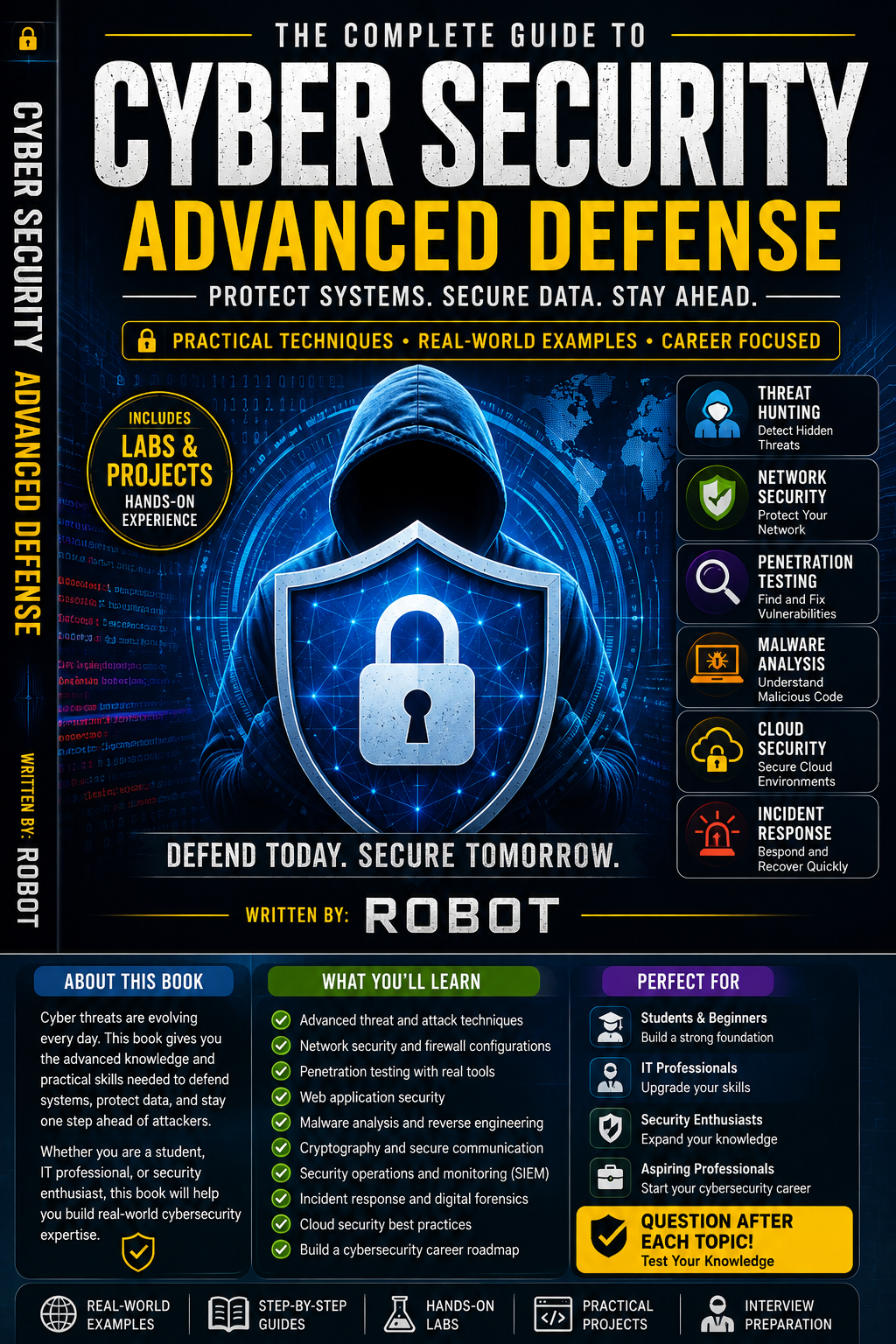
Cybersecurity Mastery
Table of Contents- Cybersecurity Architecture
- Advanced Network Defense
- Identity and Access Management
- Security Operations Centers
- Threat Intelligence
- Digital Forensics
- Incident Response
- Cloud Security
- Application Security
- Data Protection and Privacy
- Security Risk Management
- Vulnerability Management
- Security Awareness
- Ethical Security Testing
- Building a Security Lab
- Cybersecurity Career Development
- Final Cybersecurity Challenge
Cybersecurity architecture is the overall design of an organization's security controls.
A security architecture may include:
- Firewalls
- Identity management
- Endpoint protection
- Network monitoring
- Encryption
- Backups
- Security policies
A good architecture doesn't depend on one technology. Instead, multiple controls work together.
Questions
- What is cybersecurity architecture?
- Name four security controls.
- Why shouldn't an organization rely on one security control?
- What does defense in depth mean?
Networks are an important part of modern organizations.
Security teams can protect networks through:
- Segmentation
- Firewalls
- Secure protocols
- Network monitoring
- Access controls
- Secure wireless configurations
Network Segmentation
Segmentation separates different parts of a network.
For example:
Guest Network → Employee Network → Server Network
This can help prevent an attacker who gains access to one area from easily reaching everything else.
Questions
- What is network segmentation?
- Why can segmentation improve security?
- Name three network security controls.
- Why should guest devices be separated from sensitive systems?
Identity and Access Management, or IAM, controls who can access systems and what they are allowed to do.
Important IAM concepts include:
Authentication
Proving who you are.
Authorization
Determining what you can access.
Least Privilege
Giving users only the permissions they need.
Multi-Factor Authentication
Using multiple forms of verification.
Questions
- What does IAM stand for?
- What is authentication?
- What is authorization?
- What is least privilege?
- How does MFA improve account security?
A Security Operations Center (SOC) is a team or function responsible for monitoring and responding to security events.
SOC analysts may examine:
- Login events
- Network activity
- Malware alerts
- Endpoint activity
- Security logs
They investigate unusual activity and determine whether further action is required.
Questions
- What is a SOC?
- What does a SOC analyst do?
- Name three types of information a SOC might monitor.
- Why is continuous monitoring useful?
Threat intelligence is information that helps security teams understand potential threats.
It can help organizations understand:
- Who might target them
- What types of threats exist
- Which vulnerabilities are being exploited
- What warning signs defenders should monitor
Threat intelligence can help organizations make better security decisions.
Questions
- What is threat intelligence?
- Why is threat intelligence useful?
- What types of information can threat intelligence provide?
- How can threat intelligence help defenders?
Digital forensics involves examining digital evidence to understand what happened during a security incident.
Evidence can include:
- System logs
- Files
- Device information
- Application records
- Network records
Investigators must preserve evidence carefully.
The objective is to establish what happened using reliable evidence.
Questions
- What is digital forensics?
- Name three types of digital evidence.
- Why is evidence preservation important?
- What should investigators base their conclusions on?
When a serious security event occurs, organizations need a response plan.
A typical process includes:
Preparation → Detection → Containment → Eradication → Recovery → Lessons Learned
Preparation
Create procedures before an incident happens.
Detection
Identify suspicious activity.
Containment
Limit the damage.
Eradication
Remove the cause of the incident.
Recovery
Restore normal operations.
Lessons Learned
Review the incident and improve defenses.
Questions
- What is incident response?
- Why is preparation important?
- What does containment mean?
- What happens during recovery?
- Why are lessons learned important?
Cloud services provide computing resources over the internet.
Examples include:
- Cloud storage
- Databases
- Virtual machines
- Applications
Cloud security requires careful management of:
- User accounts
- Permissions
- Data
- Configurations
- Logging
A common security problem is accidentally making sensitive resources accessible to the wrong people.
Questions
- What is cloud computing?
- Name three cloud resources.
- Why are cloud permissions important?
- Why should cloud configurations be reviewed regularly?
Applications can contain vulnerabilities if security isn't considered during development.
Secure application development includes:
- Strong authentication
- Access controls
- Input validation
- Secure configuration
- Safe handling of sensitive data
- Regular security testing
Security should be considered throughout the development lifecycle.
Questions
- What is application security?
- Why is input validation important?
- Name three secure development practices.
- When should security be considered during development?
Organizations store valuable information.
Examples include:
- Customer information
- Password credentials
- Business documents
- Personal information
Security teams should protect data from unauthorized access, accidental loss, and inappropriate disclosure.
Important techniques include:
- Encryption
- Access controls
- Backups
- Data classification
- Secure disposal
Questions
- Why is data protection important?
- Name four methods of protecting data.
- What is encryption?
- Why should access to sensitive information be limited?
Risk management helps organizations identify and reduce potential problems.
A simple process is:
Identify → Assess → Treat → Monitor
For example, an organization might discover that an important computer system is running outdated software.
The security team can assess the risk and determine what action should be taken.
Questions
- What is risk management?
- What are the four steps described in this chapter?
- Why should organizations assess security risks?
- Give one example of a security risk.
A vulnerability is a weakness that could potentially be exploited.
Vulnerability management includes:
- Discovering systems.
- Identifying weaknesses.
- Assessing their importance.
- Prioritizing fixes.
- Applying updates or other protections.
- Verifying that the problem has been addressed.
Regular vulnerability management helps organizations reduce exposure.
Questions
- What is a vulnerability?
- Why should vulnerabilities be prioritized?
- What is vulnerability management?
- Why should organizations verify fixes?
Technology cannot solve every security problem.
People are also an important part of cybersecurity.
Security awareness training can teach people to recognize:
- Phishing
- Suspicious attachments
- Fake login pages
- Social engineering
- Unsafe password practices
A strong security culture encourages people to report suspicious activity instead of ignoring it.
Questions
- Why is security awareness important?
- Name three threats employees should learn to recognize.
- Why should suspicious activity be reported?
- How can training improve cybersecurity?
Security testing can help organizations discover weaknesses.
However, testing must always be authorized.
An ethical security tester should:
- Obtain permission.
- Follow the agreed scope.
- Protect sensitive information.
- Avoid unnecessary disruption.
- Document findings.
- Report vulnerabilities responsibly.
Never test a website, account, network, or computer simply because you can access it.
Questions
- What is ethical security testing?
- Why is permission required?
- What is testing scope?
- Name three responsibilities of an ethical tester.
A cybersecurity lab provides a safe environment for learning.
A beginner-friendly lab can use:
- A computer
- Virtual machines
- Intentionally vulnerable training applications
- Network simulations
- Security-learning platforms
Practice should remain inside systems specifically designed for training or systems you have permission to test.
Questions
- What is a cybersecurity lab?
- Why are isolated environments useful?
- What types of systems can be used for cybersecurity practice?
- Why should beginners avoid testing random systems online?
Cybersecurity contains many career paths.
You could eventually explore roles such as:
- SOC analyst
- Security engineer
- Cloud security specialist
- Digital forensics analyst
- Incident responder
- Security administrator
- Security consultant
- Penetration tester
Important skills include:
- Networking
- Operating systems
- Programming
- Problem-solving
- Communication
- Research
- Critical thinking
Questions
- Name five cybersecurity careers.
- Why is networking knowledge useful?
- Why is communication important?
- Why should cybersecurity professionals keep learning?
You've reached the final chapter.
Imagine that you are part of a cybersecurity team protecting a small company.
The company has:
- 25 employees
- A website
- A cloud database
- Employee laptops
- Wi-Fi
- Customer information
One morning, the security team notices unusual login activity.
Your Challenge
Answer these questions:
Question 1
What should the security team investigate first?
Question 2
What evidence could help determine what happened?
Question 3
How could the team contain the incident?
Question 4
What security controls could help prevent similar incidents?
Question 5
Why should the team document everything?
Final Review Quiz1. What does IAM manage?
A. Internet speed
B. Identity and access
C. Computer temperature
D. Website colors
2. What does a SOC do?
A. Designs logos
B. Monitors and responds to security events
C. Creates music
D. Repairs cars
3. What is threat intelligence?
A. Information about potential threats
B. A type of computer monitor
C. A programming language
D. A backup device
4. What is a vulnerability?
A. A security weakness
B. A password manager
C. A firewall
D. A backup
5. What is the first priority during many security incidents?
A. Ignore the problem
B. Understand and contain the incident appropriately
C. Delete all evidence
D. Share private information publicly
Answer Key- B — Identity and access
- B — Monitors and responds to security events
- A — Information about potential threats
- A — A security weakness
- B — Understand and contain the incident appropriately
Cybersecurity is a constantly changing field.
The strongest cybersecurity professionals don't just learn tools. They learn how to think critically, investigate problems, protect information, and respond responsibly.
Keep practicing in safe environments.
Keep learning.
Keep asking questions.
And always use your cybersecurity knowledge ethically.